Dealing with the challenges of a post-conflict context, Côte d’Ivoire has carried out efforts through several mechanisms to contribute to reconciliation and promote the prevention of mass atrocities. Understanding that atrocity prevention is an approach that concerns the whole society, CADHA, a GAAMAC partner in Côte d’Ivoire, implemented two seminars oriented towards members of the National Gendarmerie and media professionals.
The activities took place on 5 and 14 March 2024 in Abidjan and involved 25 journalists and other media professionals, and 30 members of the National Gendarmerie.
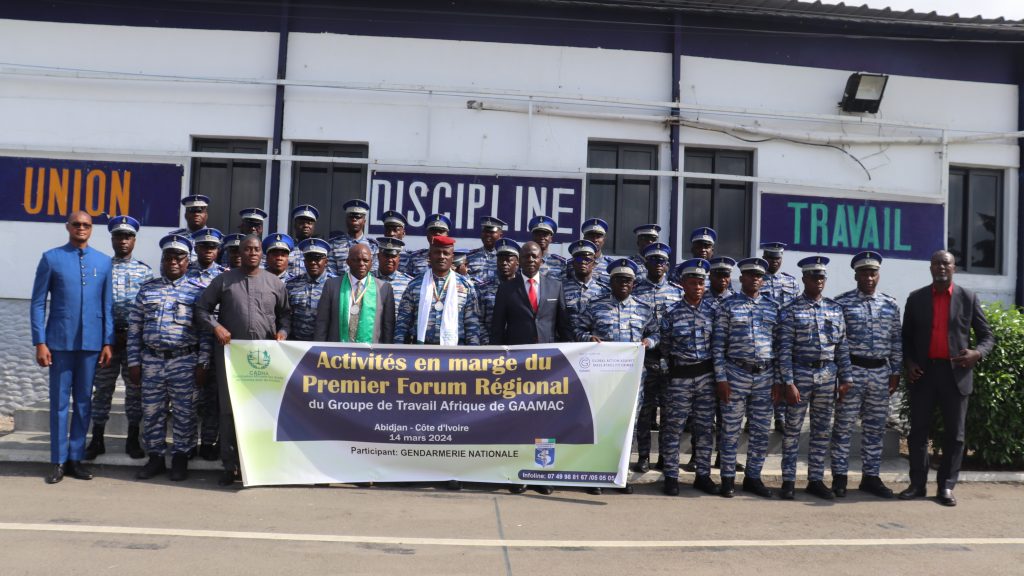
Awareness-raising training, Abidjan Gendarmerie School
14 March 2024
The event at the Abidjan Gendarmerie School was divided into three sections and led by Mr. Bakari Diaby, General Coordinator of CADHA and Vice-Chair of the GAAMAC Africa Working Group. Mr. Diaby opened the event by highlighting the role of CADHA in fostering the promotion of national atrocity prevention mechanisms in collaboration with other relevant actors.
In the first module of the seminar, which focused on national mechanisms for the prevention of mass atrocities, Mr. Diaby presented the Manual on Best Practices for the Establishment and Management of National Mechanisms for Genocide and Mass Atrocities Prevention, launched by the GAAMAC Africa Working Group in 2019. The objective was to demonstrate that prevention can take various forms and to explore the different ways of achieving the desired results. He explained that the Manual on Mass Atrocities Prevention can be adapted to different contexts by incorporating relevant elements and tailoring it for better understanding and more effective support in the implementation of national mechanisms.
The second module was presented by Honorary Colonel-Major Jean-Hubert Ouassenan, who addressed the interaction between International Humanitarian Law and Human Rights Law. This session was followed by a presentation from Mr. Berthe Nanourou, Deputy General Coordinator of CADHA, who covered the module on Civil Protection. The second half of the event was dedicated to a discussion on the Rights and Freedoms of the Armed Forces members and the Military Tribunal.
The event concluded with a closing session during which representatives of the Gendarmerie School of Abidjan expressed their appreciation for the initiative. The group acknowledged the importance of periodic training and emphasized the need for it to be extended to the entire National Gendarmerie of Côte d’Ivoire.
Capacity Building Training, Maison de la Presse, Abidjan
5 March 2024
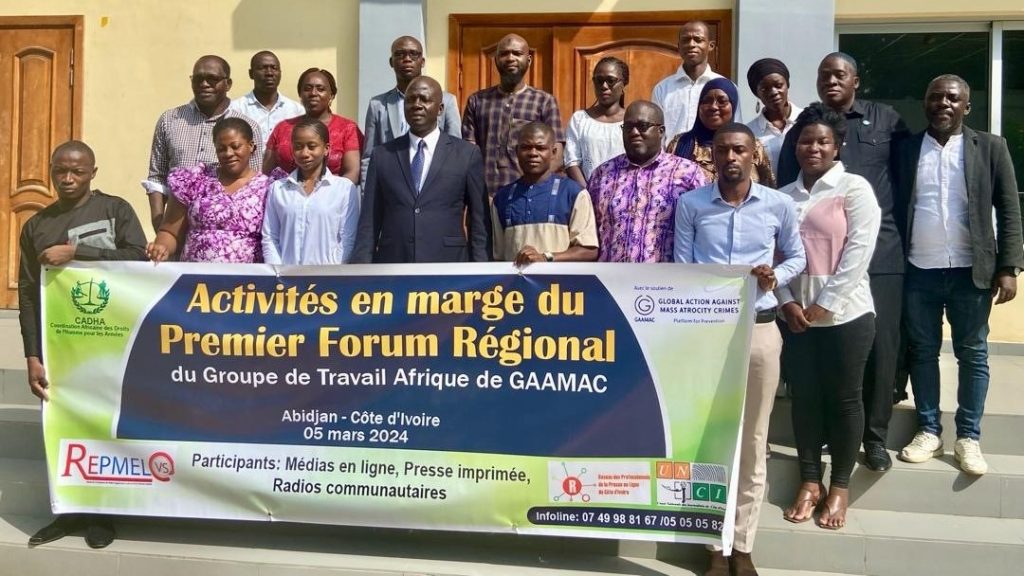
On 5 March 2024, CADHA organized a capacity-building training session for journalists and media professionals. The objective of this training was to equip these professionals with the tools needed to enhance their involvement in the prevention of mass atrocities.
The training took place at the Maison de la Presse in Abidjan and was attended by 25 media professionals from various sectors, including online press, community radios, and newspapers.
The event began with an opening ceremony, in which Ms. Assetou Kone, Communications Manager at CADHA, and Mr. Bakari Diaby welcomed the participants and emphasized the crucial role of the media in peacebuilding and atrocity prevention.
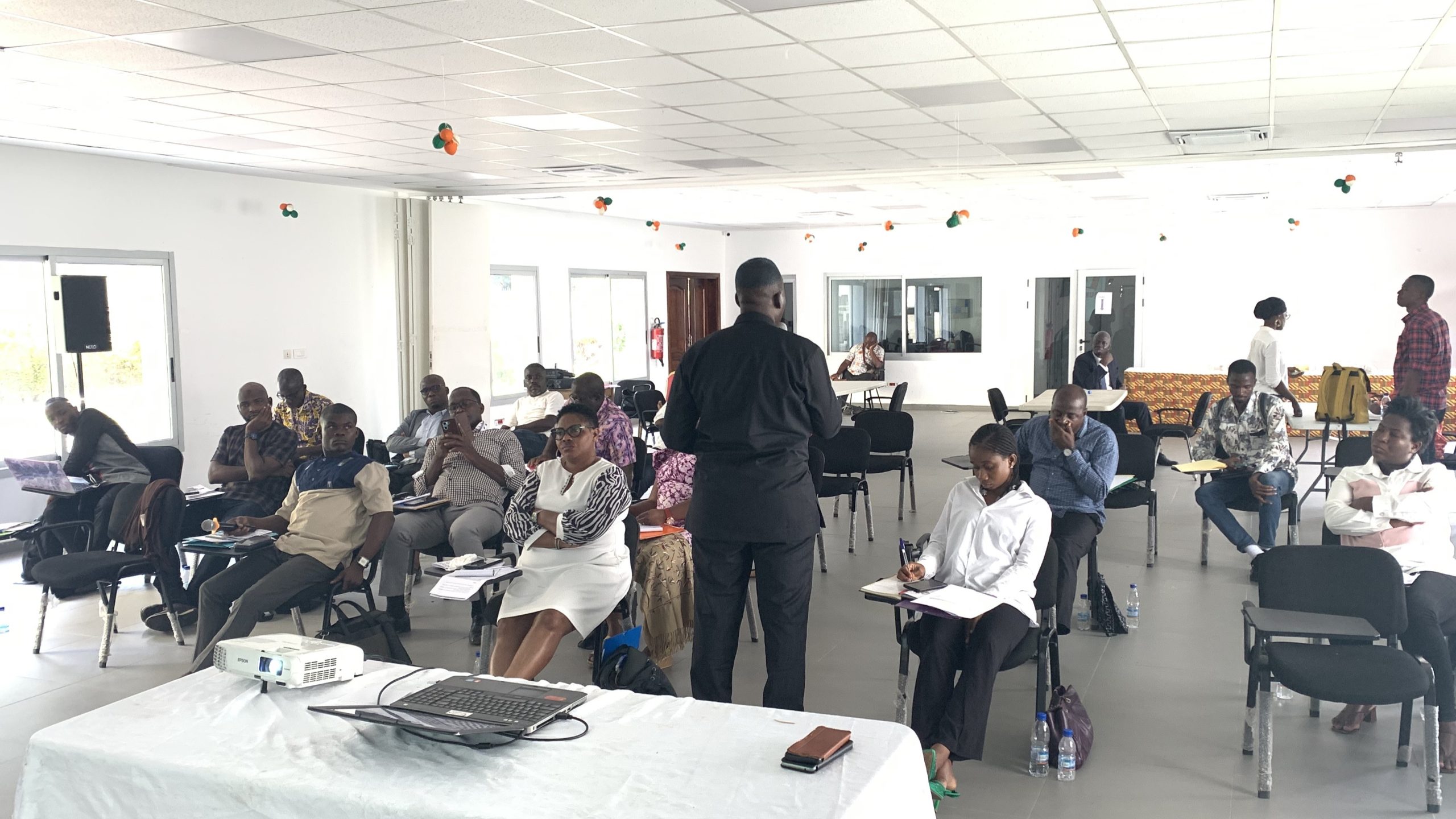
Following the opening ceremony, the training sessions took place. The training was divided into six modules: the notion of mass atrocities; hate speech, fake news and rumors; national mechanisms for the prevention of atrocities; the responsibility to protect, and practical cases of reporting on mass atrocity crimes. These modules were presented by three experts: Mr. Bakari Diaby, Lt. Nanourou Berthé, and web journalist Mr. Mamadi Kébé.
The training
Mr. Diaby opened the first module by introducing the concept of mass atrocities to the participants. He highlighted the factors contributing to mass atrocities in Africa and emphasized the media’s responsibility in disseminating accurate information. This session was followed by a discussion on fake news and rumors. In the discussion on hate speech, participants were encouraged to prevent incitement to discrimination and violence, protect victims, and strengthen partnerships with stakeholders.
The training also explored the role of journalists and civil society actors in civilian protection. He explained that prevention mechanisms can be implemented before, during, and after the occurrence of mass atrocities, mainly through addressing identified threats and risks. Journalists were reminded of their duty to denounce human rights violations. The training concluded with a role-play designed to assess participants’ understanding of the discussions on the prevention of mass atrocities.
GAAMAC consistently supports locally owned initiatives that build and strengthen national architectures and policies to prevent atrocities through exchange, dialogue, and dissemination of learning and good practice. CADHA has been a highly active partner, raising awareness and increasing understanding and support towards an upfront and permanent atrocity prevention agenda in Côte d’Ivoire.